
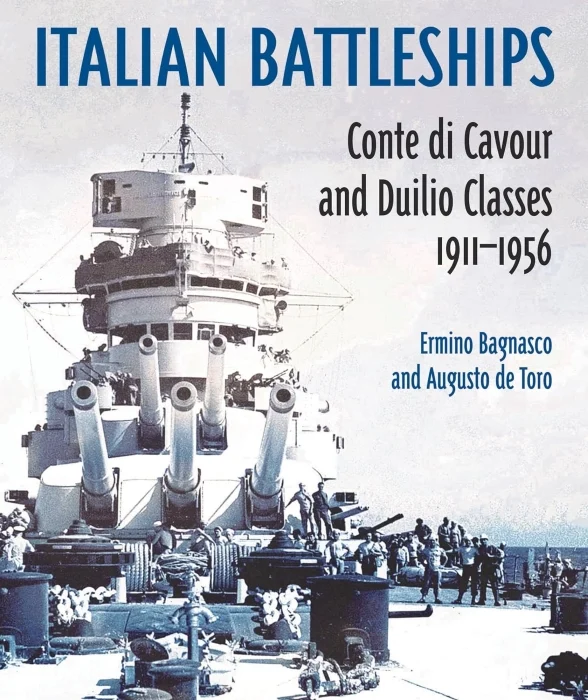
Descrizione
With the publication of their previous book on the battleships of the Littorio Class, the authors set new standards for thedetailed coverage and sophisticated analysis of Italian warship design. Inspired by its success, both critically and commercially, the authors were inspired to follow up with a similar study of the earlierItalian battleships that were built in the First World War but survived to fight in the Second. Given the level of new research required, this has taken a decade to achieve, but the result is a similarly comprehensive coverage.
Originally comprisingfive ships in two related classes, they entered service at the beginning of the Great War. As designed, they were powerful examples of the second generation of dreadnoughts, with a combination oftwin and triple turretsproducing a unique main armament ofthirteen 12-inch guns. One ship,Leonardo da Vinci, was sunk by an internal explosion at Taranto in 1916 and, although the hull was raised post-war, the plan to rebuild the ship was abandoned as it was not deemed cost-effective.
However, the remaining four ships were to undergo one of the mostradical reconstructionsof any battleship classduring the 1930s, emerging with an entirely new profile, more powerful machinery and all the characteristics of a modern fast battleship. In this form they became an important element in the Italian fleet that opposed the British after 1940. This book coversall the technical details of the ships, both as built and as rebuilt, but also providesan extended history of their active service, includingbattle plans and track charts.
Thoroughly illustrated withphotographs, ship and armament plans, detail drawings and colour camouflage schemes, the book is a fitting companion toThe Littorio Class.
Drawings by Roberto Maggi and Maurizio Brescia.
Edition: 2021


Recensioni
Ancora non ci sono recensioni.